

Expressive Florals - A 4 Week Acrylic Course
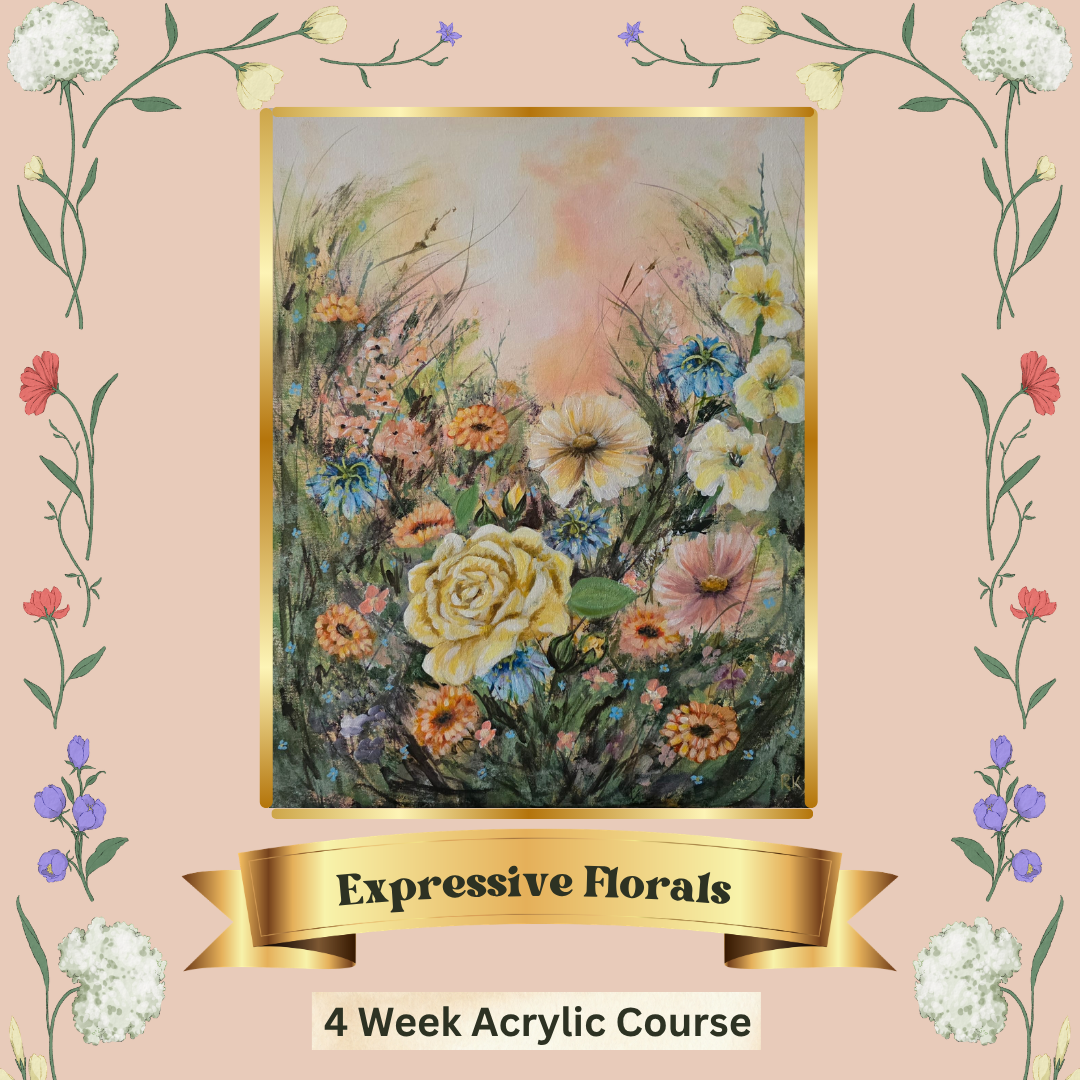
Expressive Florals
A Four-Session Acrylic Painting Course
Four longer painting sessions
Every second Thursday
One expressive floral painting that develops with you
Size A2 Canvas
Class Days & Times
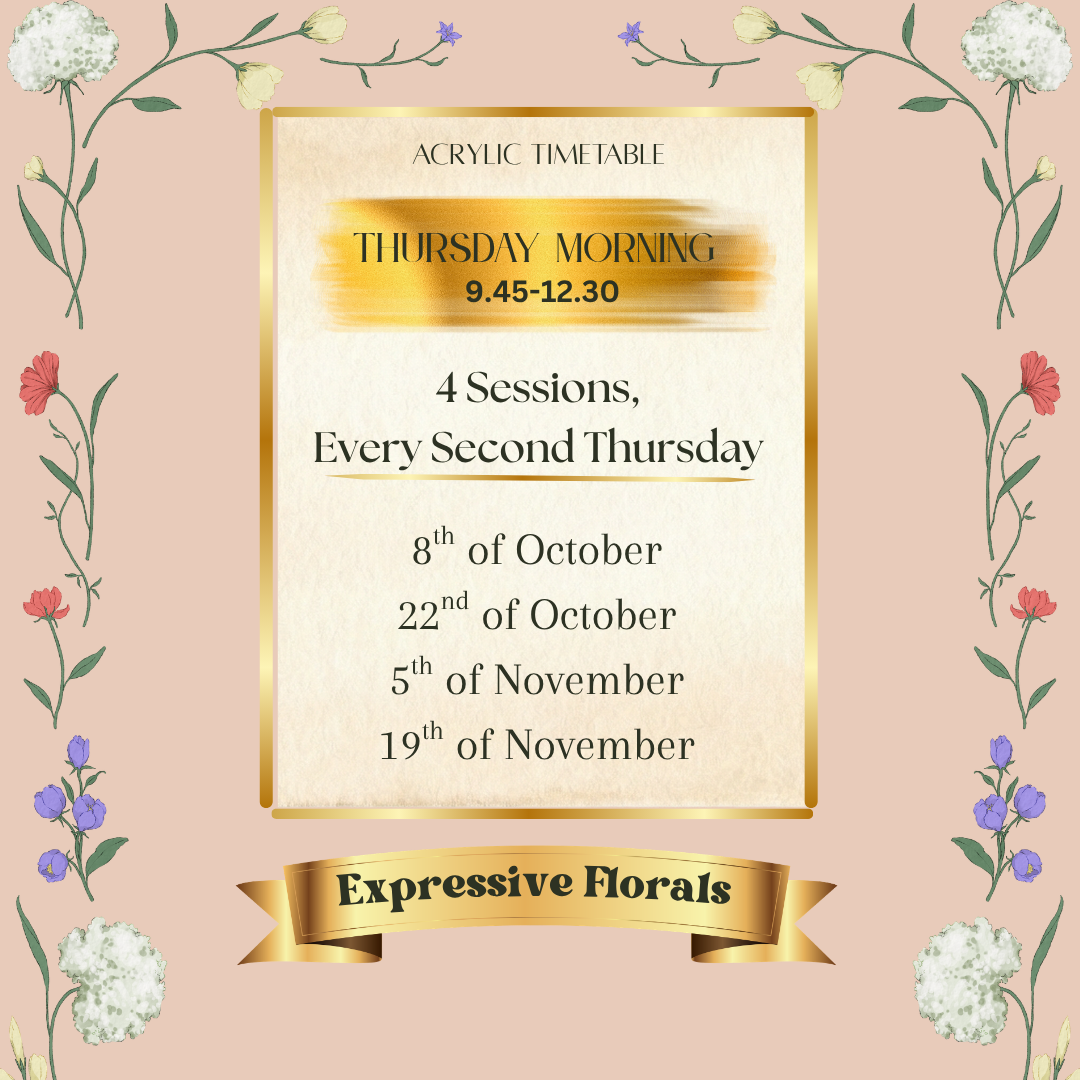
Thursday Daytime
9:45am – 12:30pm
or
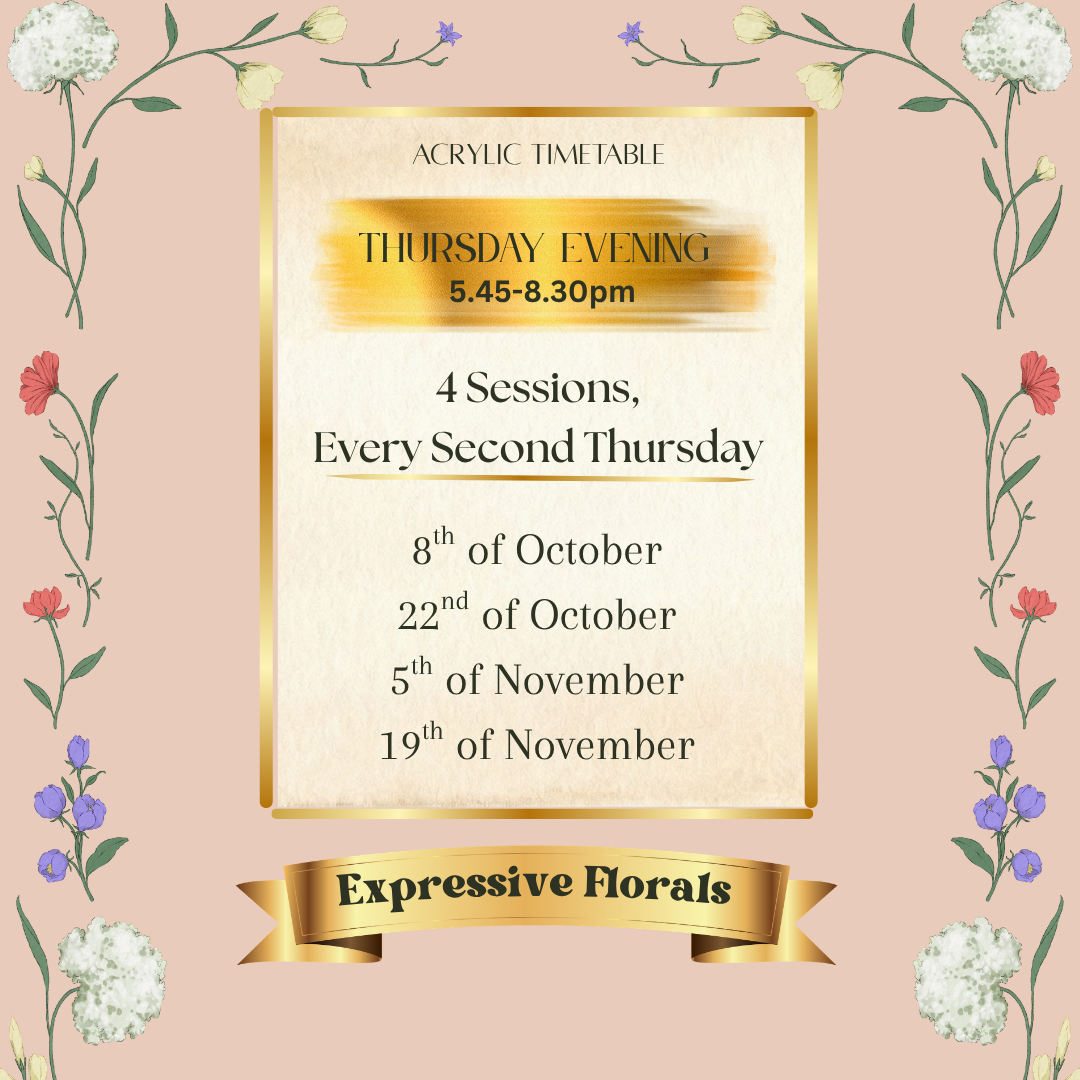
Thursday Evening
5:45pm – 8:30pm
Course Dates
Thursday 8th October
Thursday 22nd October
Thursday 5th November
Thursday 19th November
You will have the option to book either the Daytime Course or the Evening Course and attend the same time across all four sessions.
This acrylic course is all about you.
Over four longer painting sessions, held every two weeks, we'll work on one expressive floral acrylic painting, developing it slowly from the very first layers through to the finished piece.
This isn't a workshop where everyone follows exactly the same steps and leaves with the same painting.
Instead, I'll teach and support you through the process of creating your own painting.....choosing flowers and colours, developing a composition, creating atmosphere, understanding light and dark, building depth and learning when to add, when to take away and when to simply leave something alone.
The finished painting should feel like you.
Before your first class...
I'd love you to have a little think about where your finished painting might eventually live.
Perhaps it's for your living room, bedroom or hallway. Have a look at the colours already in that space and think about how you would like the painting to feel there.
Or perhaps you're creating it as a gift. Think about that person's home, the room it might hang in and whether there are particular flowers or colours that mean something to them.
You can also begin thinking about flowers.
Which are your favourites? Are there flowers from your garden you'd love to include? Flowers that remind you of someone? Perhaps you simply love the shape of a cosmos, the delicacy of nigella or the drama of a big blousy rose.
You're very welcome to bring photographs on your phone, printed reference photographs or even a photograph of the room or wall where you'd eventually like the painting to hang.
But please don't feel you need to have any of this worked out!
You can book this course with absolutely no idea what flowers you want to paint, what colours you want to use or what your finished painting is going to look like.
I'll have plenty of floral reference photographs available in the studio and we can look at ideas together.
In fact, sometimes not having a fixed plan can be better.
Your painting might start heading in a completely different direction once you begin. You may discover a colour combination you hadn't considered. A flower you hadn't planned might suddenly be exactly what it needs. Something you were convinced would be in the painting might disappear altogether.
And that's part of painting.
This isn't a rigid workshop with a predetermined end result.
It's designed to flow and develop over the four sessions. I'll help you respond to what's actually happening on your canvas rather than feeling that you have to make it match an idea you had before you started.
---
Session One — Finding Your Direction
Our first session is about ideas, atmosphere and composition.
If you've brought photographs or ideas, we'll look at them together. If you haven't, we'll find your starting point in class.
We'll think about your flowers, colours and the overall feeling you want to create before beginning those first layers.
We'll explore:
- Composition and placement
- Choosing a colour palette
- Creating mood and atmosphere
- Light and dark
- Beginning an expressive background
- Building the first acrylic layers
- Planning without making a painting feel overly planned
By the end of the first session, you'll have established the foundations of your painting — but we'll still leave plenty of room for it to change.
---
Session Two — Building Flowers, Layers & Depth
Now we'll begin developing our flowers and building more depth into the painting.
I'll demonstrate how I approach individual flowers, looking at colour mixing, layering, brushwork, transparent and opaque paint and how much — or how little — detail a flower actually needs.
You might spend a considerable amount of time developing one flower, and that's absolutely fine.
I'll work alongside you, helping you understand how to build that flower rather than simply asking you to copy what I'm doing.
We'll also begin stepping back from the individual flowers and looking at the painting as a whole.
Does it need another flower?
Does somewhere need to be darker?
Are things becoming too evenly spaced?
Where does your eye go first?
Is there an area that needs to be quieter?
At the end of Session Two, we're only halfway through.
Your painting doesn't need to look finished — and I don't want you worrying if it doesn't.
---
Session Three — Step Back, Balance, Add & Take Away
This is where things get really interesting.
We'll come back to our paintings after two weeks away and look at them with fresh eyes.
Rather than automatically adding more, we'll learn to ask:
What does this painting actually need?
We'll explore balance, negative space, values, light and dark, depth and how the eye travels around a painting.
Sometimes we'll add.
Sometimes we'll strengthen.
Sometimes we'll soften.
And sometimes we'll take something away.
We'll look at expressive marks, layering and lost and found edges, allowing some flowers to remain beautifully loose while bringing others forward with more detail.
This is often the point where everyone's paintings really begin to go in completely different directions
---
Session Four — Bringing Your Painting Together
Our final session is about looking at the painting as one complete piece, rather than lots of individual flowers.
We'll refine, edit and make those final decisions.
Does somewhere need another layer?
Could a darker area make your lighter flowers stand out?
Does something need softening?
Would one little highlight make all the difference?
Or are you about to add something that the painting really doesn't need?
We'll work on final layers, expressive marks, highlights, edges and those small adjustments that can completely change how a finished painting feels.
And we'll tackle one of the hardest skills in painting:
knowing when to stop.
---
Why is there a two-week gap between classes?
Quite deliberately, this course runs every second week.
A painting like this doesn't need to be rushed.
You'll have the option to take your canvas home between sessions and continue working on it if you'd like to.
I could quite happily spend three hours painting one flower!
So during class, I may work through a flower with you, helping you understand the colours, layering, brushwork and decisions I'm making. You can then take those skills home and, if you want to, spend time developing another two or three flowers before our next session.
When you return, we'll look at what's happened and work out together where to go next.
The two-week break also gives you something incredibly valuable:
time away from your painting.
Sometimes you need to stop looking at something before you can see it properly again.
---
But there is absolutely no homework!
If you want to take your canvas home and spend hours painting between sessions, brilliant.
If you want to leave it in the studio, forget all about it for two weeks and pick your brush back up when you return, also brilliant.
There is no expectation that you work on your painting at home.
Each session is 2 hours 45 minutes....longer than our usual watercolour classes, giving you a total of 11 hours of supported studio painting time.
There's plenty of time within the course itself to create something beautiful.
---
What if I've never painted before?
Come along.
You absolutely do not need previous acrylic painting experience.
I'll support you throughout the process, from those first decisions and first marks right through to developing your flowers and finishing your painting.
And if you've painted for years and want to push your work further, this course is equally for you.
Rather than simply teaching you how to recreate my painting, we'll go much deeper into composition, colour, values, depth, layering, expressive brushwork and editing your own work.
Whether you're picking up acrylics for the first time or you've been painting for years, the aim is the same:
To give you the skills and confidence to make decisions about your own artwork.
There won't be a row of identical paintings leaving the studio at the end of our four sessions.
There will be a collection of completely individual paintings — different flowers, different colours, different moods and different stories.
And one of them will be entirely yours.